Sunday, May 11, 2014

Comunismo (Vocabulario)

Comunismo

  1. m. Doctrina de organización política y económica que propugna la abolición de la propiedad privada y el establecimiento de una comunidad de bienes.
  2. Doctrina iniciada por Marx y Engels que interpreta la historia como una continua lucha de clases cuyo fin es el logro de una sociedad sin diferencias sociales ni propiedad privada, de la que haya desaparecido el Estado.
  3. Movimiento político inspirado en esta doctrina:
    el comunismo ha perdido vigencia en la Europa actual.

Comunismo

  • marxismo, leninismo, maoísmo, estalinismo
    • Antónimos: capitalismo
 

Capitalismo (Vocabulario)


Capitalismo

  1. m. Régimen económico basado en el predominio del capital como elemento de producción y creador de riqueza sin apenas intervención del Estado.
  2. Conjunto de partidarios de esta doctrina:
    el capitalismo ha triunfado en Occidente.

Capitalismo

  • liberalismo, librecambismo, industrialismo, plutocracia, mercantilismo
    • Antónimos: socialismo, marxismo, cooperativismo
 

Salvador Dalí (Wikipedia)


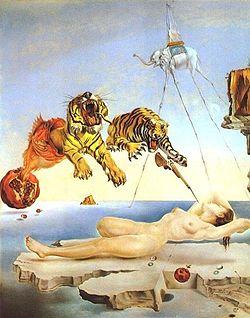
Salvador Felipe Jacinto Dalí i Domènech,1 marqués de Dalí de Púbol (Figueras, 11 de mayo de 1904 – ibídem, 23 de enero de 1989), fue un pintor, escultor, grabador, escenógrafo y escritor español, considerado uno de los máximos representantes del surrealismo.

Dalí es conocido por sus impactantes y oníricas imágenes surrealistas. Sus habilidades pictóricas se suelen atribuir a la influencia y admiración por el arte renacentista. También fue un experto dibujante.2 3 Los recursos plásticos dalinianos también abordaron el cine, la escultura y la fotografía, lo cual le condujo a numerosas colaboraciones con otros artistas audiovisuales. Tuvo la habilidad de forjar un estilo marcadamente personal y reconocible, que en realidad era muy ecléctico y que «vampirizó» innovaciones ajenas. Una de sus obras más célebres es La persistencia de la memoria, el famoso cuadro de los «relojes blandos», realizado en 1931.

Como artista extremadamente imaginativo, manifestó una notable tendencia al narcisismo y la megalomanía, cuyo objeto era atraer la atención pública. Esta conducta irritaba a quienes apreciaban su arte y justificaba a sus críticos, que rechazaban sus conductas excéntricas como un reclamo publicitario ocasionalmente más llamativo que su producción artística.4 Dalí atribuía su «amor por todo lo que es dorado y resulta excesivo, su pasión por el lujo y su amor por la moda oriental» a un autoproclamado «linaje arábigo»,5 que remontaba sus raíces a los tiempos de la dominación árabe de la península ibérica.


Galería


Color Therapy: Change your Underwear, Change your Mood

 
Natural Wisdoms: A regular feature:

Color is an amazing gift from nature. It is a living vibrational energy that is perceived and absorbed by your senses. It has a subtle yet potent interaction with your emotions and brain.

The colors you wear can reflect how you are feeling to the world, you can intentionally wear colors to shift your mood or you can hide from the world (blacks the color which shrinks your presence)

There are colors which stimulate the thinking (left) side of your brain and colors which stimulate the creative (right) side of your brain. There are colors to help you relax and others to energise and excite. Whilst some colors encourage communication others evoke stillness.

Did you know that yellow is the first color perceived by the human eye.

Below are some useful insights from my journey with color workshops over the past two decades.

Change your underwear: Change your mood:


Simply by changing the color of your underwear you can subtly fuel your energy reserves or balance your emotional needs. It is easy to do, no one need know what you are doing and I guarantee you will feel a difference.

Feeling tired grab a red pair, stressed out try some calming blue, emotionally upset go for the orange or in need of some optimism switch to yellow.

Color you world for balance:

1: Red will give you a boost of energy whilst stimulating your immune system. Red can activate your appetite - beware. It evokes action and passion and a perfect color if you tend to be a procrastinator.


2: Orange will allow you to digest your emotions without holding onto stuff and encourage emotional balance and optimism. It is warm hearted and offers a sense of community whilst offering a feeling of tolerance. Perfect color for social gatherings.


3: Blue is tranquil and peaceful. It has been proven to reduce pain levels. It aids in acquiring inner peace and supports creativity. Blue is associated with the right hand side of the brain.


4: Green refreshes, encourages growth, is balancing and healing. It is nurturing and associated with the heart. Green promotes prosperity and well being. Green of course is a combination of blue and yellow.


5: Yellow lifts your spirits and offers you a positive feeling. It evokes confidence and joy. It is connected to your mental thinking and improves attention to detail and academic achievement. It improves concentration and clarity of thought.


6: Purple is known to heighten your intuition. It is similar to blue in that it offers comfort and calm. A great color for meditation.


Experiment with color:
 
Don’t take my word for it though, experiment for yourself. Notice how different you feel wearing blue or orange or even red undies or any item of clothing.

To further excite you into experimenting with color therapy I’ve added a few special treats to whet your appetite.
 
Color your wallet for wealth:

 
Years ago after listening to a color therapist a group of my girlfriends all switched to green wallets. Green represents growth, abundance and prosperity. It is the color most often associated with money. In Feng Shui green relates to the wood energy which is associated with wealth. You might also like to read the Tao of a full happy wallet if you are keen to boost your money vibes.

Lose weight with color:

 
Research has shown that blue is the most likely color to suppress your appetite. A blue light in your fridge may be just the trick you need. Blue is not a color you think of when you imagine food. Nature does not offer many blue foods except for a few such as blueberries. Red will stimulate your appetite and encourage fast eating. Notice how many take-aways have red signs or decor.

Labeling


Labeling is a kind of jumping to conclusions in which we apply a negative term to a complex person or event. It often also entails overgeneralization because we tend to label all the members of a group with the characteristics we may have seen in some. Often its most damaging form is self-labeling. We all do it. If someone who has just met you asks you who you are or what you do, you are likely to respond by labeling yourself: "I'm a student," or "I'm an electrician," or "I'm a history major." Such labels always leave out much more than they include. But if we take them with a grain of salt they probably don't do much harm. What does a lot of harm is an evaluative label we apply based on past experience. A lot of students have told me, "I'm a poor English student," or "English is my worst subject." But as far as I can tell, good students are as likely to label themselves in this way as poor ones. So I conclude that these students have labeled themselves on the basis of weak evidence. When I question such students I usually find that the fact behind a label such as "I'm a poor English student" is something like "I got a D in the grammar portion of 10th grade English" or "I didn't like the books we read in high school literature classes."
A student once told me at the very beginning of the semester that he was a lousy writer. I asked him what he'd written. He said that he'd never written anything longer than a paragraph in high school. I asked him how he could possibly know he was lousy at something he'd never really attempted seriously. He said that he "just knew." He had labeled himself for no very good reason. But once a negative label becomes an automatic thought it can easily act as a self-fulfilling prophecy. Nobody likes to spend time doing what he or she is not good at. So if you've labeled yourself as "dumb" or a "bad student" or "no good at English/math/history/geography/biology" you will expect to do poorly in it, and you probably will.

Labeling others can be as damaging as labeling ourselves. Labeling reinforces stereotypes about groups of people and, in general, encourages us to say and do stupid things. I am amazed at the speed with which many students label a book "boring" and then proceed as if that single vague label were all that could be said about the text in question.

The negative labels we apply to ourselves and others in our automatic thoughts are almost always vague and ambiguous because they are automatic. If you try to write an essay from your automatic thoughts--you may think of them as your "opinions"--you will find that it consists of nothing more than a string of labels. If you are going to write well about your opinions, you will have to bring them beyond the stage of automatic thoughts and give reasons for those opinions that make sense to other people. In order to do that, you'll have to define the labels you're using. If you can define your terms clearly and give evidence for your beliefs, then you have gone beyond automatic labeling and begun to engage in reasoned argument.

One form of labeling is so widespread in this business that it deserves brief mention on its own. It's called grading. Grades may or may not be necessary, but they can unquestionably do a great deal of damage if we take them too seriously. Letter grades are horribly vague and imprecise. If you doubt that, you can easily disprove it: Stop right now and write down a clear, precise, and universally applicable definition of an "A" that will allow us to tell whether a piece of work is worthy of an "A" without knowing who the teacher is or who the student is. Can't do it. That's because letter grades mean vastly different things to different people. At best, letter grades are a very rough code for a very general evaluation of a student's performance. They never answer the most important questions a student needs to ask: What did I do well? Where could I improve? Have I achieved my own goals in this course? How can I build on what I've learned? What can I do now that I couldn't do before? How can I be a more effective learner? A student who receives an "F" and knows the answers to some of these questions is better off than one who gets an "A" and never asks them. The label is an abstraction. It is never as important as the more complex reality it stands for. If we allow the label to become all important, so that we ignore the reality it is supposed to stand for, then we have yielded to this cognitive distortion in a way that seems to me to resemble the thinking of people who are seriously mentally ill. G. K. Chesterton, writing many years before the development of cognitive therapy, said that "madness is a preference for the symbol over that which it represents"(11).


Related Posts Plugin for WordPress, Blogger...