Monday, May 12, 2014

Ensayo y Estructura (Wikipedia)


El ensayo1 es un tipo de texto que brevemente analiza, interpreta o evalúa un tema de manera oficial o libre. Se considera un género literario, al igual que la poesía, la ficción y el drama.

Las características que debe tener un ensayo son las siguientes:
  • Es un escrito serio y fundamentado que sintetiza un tema significativo.
  • Posee un carácter preliminar, introductorio, de carácter propedéutico.
  • Se expresa en un estilo denso y no se acostumbra la aplicación detallada.
Es un género literario dentro del más general de la didáctica.

Estructura

La estructura del ensayo es sumamente flexible, ya que toda sistematización es ajena a su propósito esencial, que es deleitar mediante la exposición de un punto de vista que no pretende agotar un tema, como sí haría (y sistemáticamente) el género literario meramente expositivo del tratado; por eso estas indicaciones son meramente orientativas.2

Introducción

Es la que expresa el tema y el objetivo del ensayo; explica el contenido y los subtemas o capítulos que abarca, así como los criterios que se aplican en el texto,y abarca más o menos 5 renglones.

Además, esta parte puede presentar el problema que plantea al tema al cual vamos a abocar nuestros conocimientos, reflexiones, lecturas y experiencias.

Desarrollo

Contiene la exposición y análisis del mismo tema, se plantean las ideas propias y se sustentan con información de las fuentes necesarias: libros, revistas, Internet , entrevistas y otras. Constituye el 75% del ensayo. En él va todo el tema desarrollado, utilizando la estructura interna: 50% de síntesis, 15% de resumen y 10% de comentario.

Se sostiene la tesis, ya probada en el contenido, y se profundiza más sobre la misma, ya sea ofreciendo contestaciones sobre algo o dejando preguntas finales que motiven al lector a reflexionar.

Conclusión

En este apartado el autor expresa sus propias ideas sobre el tema, se permite dar algunas sugerencias de solución, cerrar las ideas que se trabajaron en el desarrollo del tema y proponer líneas de análisis para posteriores escritos.

Esta última parte mantiene cierto paralelismo con la introducción por la referencia directa a la tesis del ensayista, con la diferencia de que en la conclusión la tesis debe ser profundizada, a la luz de los planteamientos expuestos en el desarrollo.


Sunday, May 11, 2014

The Power of Baroque Music as Help for Anxiety

Baroque music i.e. music composed during the Baroque era (1600 - 1750) has been shown to have a calming effect on the brain. It is generally the slow movements of such music which has this effect.

It is believed to be it does this because the rhythm is around 60 beats per minute which is similar to a resting heartrate. The brain 'entrains' itself to rhythm. We have all noticed the tendency of our foot to tap when we hear certain types of music. This is the brain buying into the rhythm and going along with it.


We all have brainwaves which move at different frequencies depending what we are doing or thinking. An EEG recording is similar to the more familiar ECG for measuring the heart. With an EEG, however, the electrodes are placed on the head.

This is a painless procedure. The electrodes gives a readout of wiggly lines. These show the frequency of the brainwaves produced in the different areas.

brainwaves diagram showing alpha and theta

What do the different brainwave frequencies mean?


Brainwaves in a human vary from beta waves (which are upwards of 15 cycles per second) and appear very spiky, through alpha waves, theta waves, and delta waves. 

Most of the time we are awake and participating in everyday life we have beta waves.
When we are deeply asleep we have a high percentage of delta waves which are like a gently rolling ocean.

So as we fall asleep our brainwaves gradually slow through all the stages to delta. Then they move back up again as we wake.

When we dream we are usually in theta and then if this is just one dream period we then go deeper again. There is a diagram of this on the page that explains nightmares.
Alpha waves are the daytime magic ones, when we are awake.

It is during alpha that we can access our unconscious thoughts. During hypnosis the client goes into the alpha state so that their issues may be accessed without the thinking and rationalising part of the brain getting in the way.

It is thought that it is during our dreams when we sleep that we resolve issues of the day and that is done during theta.

How do we know all this?


Research in Bulgaria have found that slow Baroque music entrains the brain into alpha waves. Studies have been done whereby such music, when played in the background during lessons in junior school classrooms, has a calming effect and enables children to concentrate on their lesson far better.

I have sometimes given patients suffering from PTSD or other severe anxieties which stopped them sleeping, or gave them constant nightmares, a CD of Baroque music with the instruction to just play it quietly in the background when they go to bed. In many cases this has had a significant effect and has enabled them to sleep better, often through the night, and to reduce the occurrence of nightmares.

To feel the calming effect of this music you don't have to consciously listen to it but to allow it to play softly in the background as you do everyday tasks. 

I have found some commercially available cds of this music which are available to buy should you wish. The most famous Baroque (1600-1760) composers are probably Bach, Vivaldi, Pachelbel, Handel Telemann, Purcell, Scarlatti. It is the slow, largo, movements of their works which are relevant here. There are few CDs available at present which are made up exclusively of such tracks so you may have to put together your own. Some of the tracks can be purchased individually as mp3 downloads on Amazon and similar sites.

If you feel inclined to listen to largo music combined with the sounds of nature, then I can recommend the Solitudes series by Dan Gibson, which do just that. There are two CDs of music by Pachelbel, Forever by the Sea and In the Garden as well as Bach Forever by the Sea which incorporates his music with the sounds of the ocean. Further details of these can be found in my Amazon Store.

Pachelbel: Forever By the SeaBach: Forever By the SeaPachelbel: in the GardenBeethoven: Forever By the SeaGreat Baroque Adagios

Comunismo (Vocabulario)

Comunismo

  1. m. Doctrina de organización política y económica que propugna la abolición de la propiedad privada y el establecimiento de una comunidad de bienes.
  2. Doctrina iniciada por Marx y Engels que interpreta la historia como una continua lucha de clases cuyo fin es el logro de una sociedad sin diferencias sociales ni propiedad privada, de la que haya desaparecido el Estado.
  3. Movimiento político inspirado en esta doctrina:
    el comunismo ha perdido vigencia en la Europa actual.

Comunismo

  • marxismo, leninismo, maoísmo, estalinismo
    • Antónimos: capitalismo
 

Capitalismo (Vocabulario)


Capitalismo

  1. m. Régimen económico basado en el predominio del capital como elemento de producción y creador de riqueza sin apenas intervención del Estado.
  2. Conjunto de partidarios de esta doctrina:
    el capitalismo ha triunfado en Occidente.

Capitalismo

  • liberalismo, librecambismo, industrialismo, plutocracia, mercantilismo
    • Antónimos: socialismo, marxismo, cooperativismo
 

Salvador Dalí (Wikipedia)


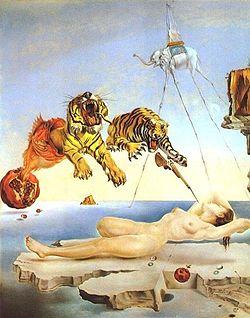
Salvador Felipe Jacinto Dalí i Domènech,1 marqués de Dalí de Púbol (Figueras, 11 de mayo de 1904 – ibídem, 23 de enero de 1989), fue un pintor, escultor, grabador, escenógrafo y escritor español, considerado uno de los máximos representantes del surrealismo.

Dalí es conocido por sus impactantes y oníricas imágenes surrealistas. Sus habilidades pictóricas se suelen atribuir a la influencia y admiración por el arte renacentista. También fue un experto dibujante.2 3 Los recursos plásticos dalinianos también abordaron el cine, la escultura y la fotografía, lo cual le condujo a numerosas colaboraciones con otros artistas audiovisuales. Tuvo la habilidad de forjar un estilo marcadamente personal y reconocible, que en realidad era muy ecléctico y que «vampirizó» innovaciones ajenas. Una de sus obras más célebres es La persistencia de la memoria, el famoso cuadro de los «relojes blandos», realizado en 1931.

Como artista extremadamente imaginativo, manifestó una notable tendencia al narcisismo y la megalomanía, cuyo objeto era atraer la atención pública. Esta conducta irritaba a quienes apreciaban su arte y justificaba a sus críticos, que rechazaban sus conductas excéntricas como un reclamo publicitario ocasionalmente más llamativo que su producción artística.4 Dalí atribuía su «amor por todo lo que es dorado y resulta excesivo, su pasión por el lujo y su amor por la moda oriental» a un autoproclamado «linaje arábigo»,5 que remontaba sus raíces a los tiempos de la dominación árabe de la península ibérica.


Galería


Related Posts Plugin for WordPress, Blogger...